

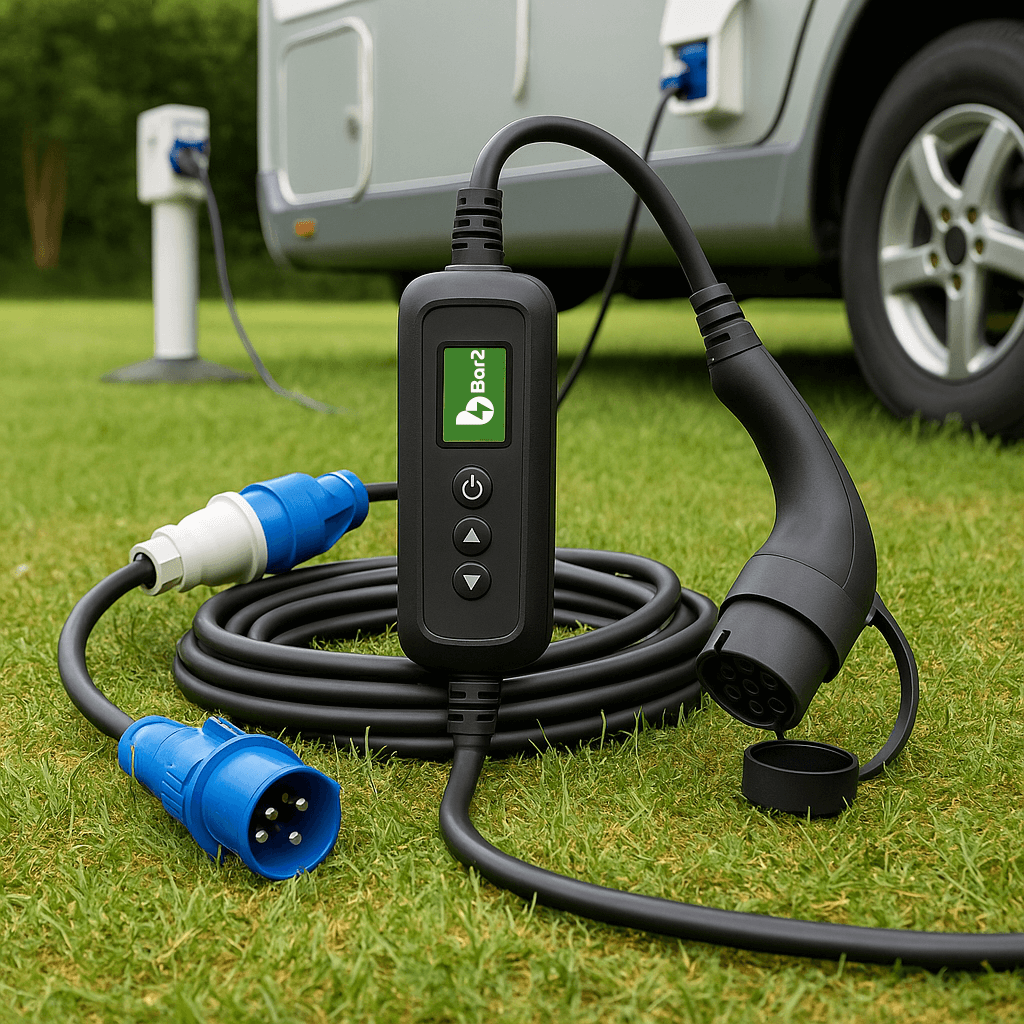
Going on holiday with an electric car? More and more people are heading out with their EV to the campsite, in the Netherlands or abroad. But how do you charge your electric car when you are not at home or there is no public charging station nearby?
The solution is often simple, but it does depend on the right cables, adapters, and power connection. In this article, we explain step by step what you need to safely charge your electric car at the campsite without stress, waiting times, or overheating.
Why charging at the campsite works differently than at home
At home, you know exactly which plug you have. But at the campsite, you have to deal with:
-
Other connections (CEE 1-phase blue, sometimes CEE red or even Schuko)
-
Limited current capacity (often 6A–10A per connection)
-
Extended distance to the power point
-
Stricter safety regulations (campsites often require fuses or surge protection)
Without preparation, it is possible that you cannot load or only very slowly. Fortunately, you can prevent this beforehand.
1. What types of connections do you find at campsites?
There are three types of power connections that are common at European campsites:
A. CEE 1-phase (blue plug, 16A)
-
The standard at many campsites in the Netherlands, France, Germany
-
Splash-proof, often in columns on the site
-
Maximum power of 3.7 kW
-
Solution: mobile charger or adapter with CEE blue
B. Schuko (standard socket)
-
Less safe and often lower power
-
Often fused at a maximum of 6A or 10A
-
Solution: Approved EV charger with protection; do not use a household extension cord.
C. CEE 3-phase (red, 16A or 32A)
-
Rarely on campsites, but at motorhome sites or farm campsites
-
Maximum 11–22 kW (if permitted)
-
Solution: powerful mobile charger with red CEE connector
View all mobile chargers and adapters here
2. Which cables and adapters do you need?
A good holiday starts with the right preparation. Here is what you need:
| Element | Function |
|---|---|
| Mobile EV charger | To charge your car via CEE or Schuko |
| CEE adapter | Fits camping pedestals with blue CEE connector |
| Extension cable (EV-approved) | Bridging of 5–10 meters |
| Plug holder | For safe outdoor cable storage |
| Protection (earth leakage + overvoltage) | Essential for campsites |
NB: Do not use standard household extension cords. These are not suitable for sustained current and can melt.
View all camping-suitable extension cables and adapters here
3. How fast can you charge at the campsite?
| Connection | Assets | Avg. charging time (per 10 kWh) |
|---|---|---|
| Schuko 6A | 1.4 kW | ± 7 hours |
| CEE blue 16A | 3.7 kW | ± 2.5 hours |
| CEE red 3-phase | 11–22 kW | ± 0.5–1 hour (often not allowed) |
⚠️ Many campsites limit the capacity to 6A or 10A per connection to prevent overloading. Check in advance whether you are allowed to use 16A.
4. Am I allowed to just charge at the campsite?
Not every campsite allows you to charge an electric car via their power connection. Pay attention to these points:
-
Ask the reception in advance: They are reserved, especially in Southern Europe.
-
Never use the power connection of your caravan and car at the same time.
-
Ensure secure chargers with certified cables.
-
Sometimes a surcharge is charged. or designated a separate charging spot for EVs
5. Smart tips for charging EVs on vacation
-
Always bring multiple adapters: Schuko > CEE blue, CEE red > CEE blue, etc.
-
Use a waterproof plug holder to safely keep cables out.
-
Plan your routes via apps such as Chargemap, Shell Recharge or PlugShare
-
Do you have solar panels on your camper or caravan? Then an inverter set with a portable charger is a smart addition.
Check out our smart camping accessories
Frequently Asked Questions
Can I charge using my caravan's socket?
No, that is strongly advised against. The internal wiring is not designed for this and poses a risk of overloading or fire.
Do I need a separate charging card at campsites?
No. You charge via the power connection of your pitch, not via a public charging station. Therefore, you do not need a charging card, but you do need the correct cables.
How much does charging cost at the campsite?
Campsites usually charge per kWh or offer a fixed electricity rate. Charging 20 kWh can take about €5–10 costs.
Conclusion: this is how you charge stress-free at the campsite
Whether you are driving to the Veluwe, the South of France, or Sweden, Charging EVs at the campsite is perfectly doable., provided you are well prepared. With the right portable charger, CEE adapter, and safe extension cable, you can charge your car anywhere.
Don't be caught off guard by unfamiliar plugs, and always check in advance what is available at your destination.
View all camping-proof chargers, cables, and accessories here